
Otero County Arrest Records and Charges
Otero County arrest records come from law enforcement and detention activity. They may identify the person arrested, the agency involved, booking or custody information, and the alleged reason for the arrest when released through the proper agency. The court charge record is different. After an arrest, the Twelfth Judicial District Attorney or another prosecutor decides what formal charges to file, and those charges become part of a court case. The charge record can change as the case moves through the court.
The Otero County Sheriff's Office is led by Sheriff David Black and is separate from the Otero County Detention Center and the court clerks. No official Otero County online jail roster, sheriff app, active warrant search, or app-only records request tool was found in the research. For custody and jail-service questions, use the detention center or inmate-record channels. For the full criminal case file and final outcome, use Otero County criminal court records. For all court case types, use the general court-record path.
The sheriff's office page appears in the image sourced from the official Otero County Sheriff's Office resource.
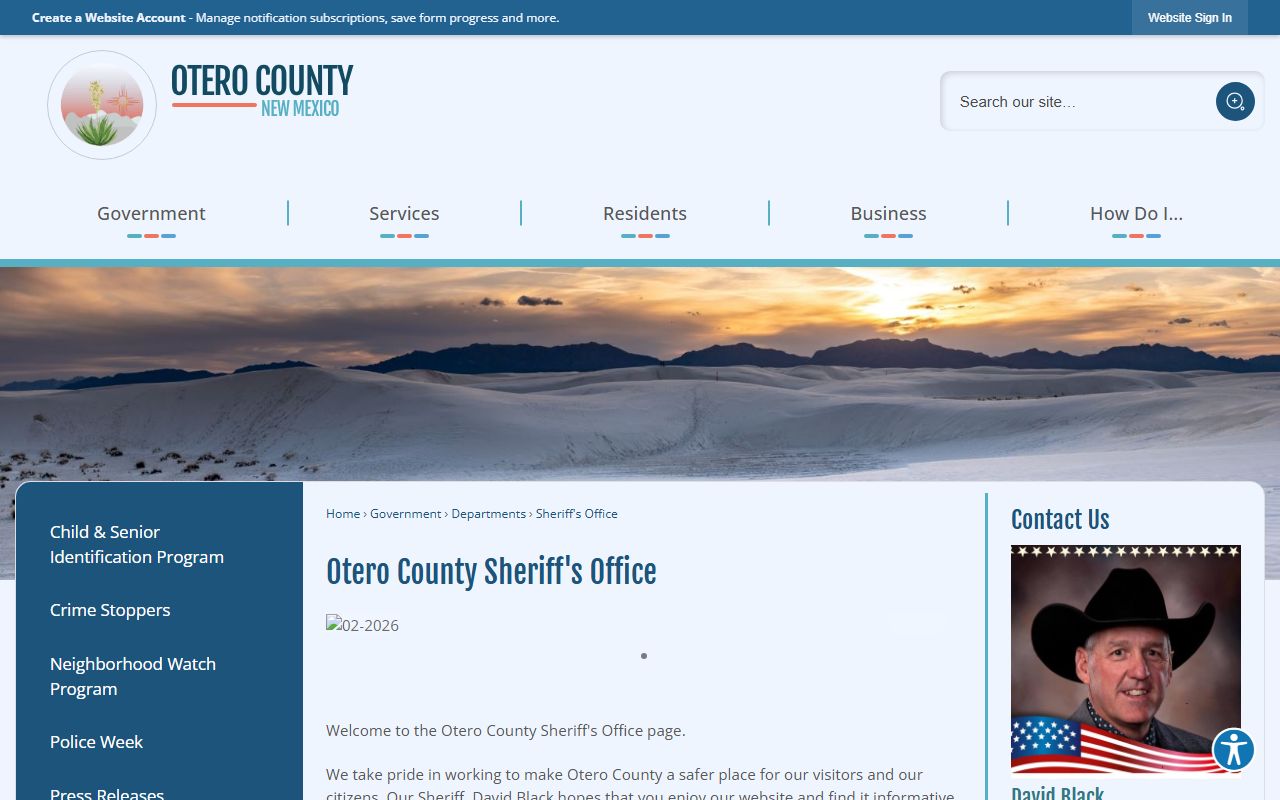
The sheriff source anchors the law-enforcement side of Otero County arrest records before those events become court charges.
Find Otero Arrest Records and Charges
There is no single official Otero County arrest-record database in the research. The practical search path depends on the question. For current custody or detention records, call the Otero County Detention Center or use county IPRA when appropriate. For charges after arrest, search New Mexico Case Lookup by defendant name or case number, then narrow by Otero District, Magistrate, or Municipal Court location. For charging decisions, diversion, victim services, and prosecution records, the Twelfth Judicial District Attorney is the local prosecutor for Otero and Lincoln Counties.
- Identify whether the question is about arrest custody, court charges, or final court outcome.
- Use sheriff, detention, or county IPRA channels for arrest and booking records when available.
- Use New Mexico Case Lookup for charges filed in Otero District, Magistrate, or Municipal Court.
- Read each charge line with the disposition, because a charge can be changed, reduced, or dismissed.
- Contact the District Attorney, court clerk, or detention center only for records that office actually holds.
The Twelfth Judicial District Attorney home page appears in the image sourced from the official District Attorney website.
The DA source matters because the prosecutor decides which charges after arrest become court-filed accusations.
Charges After Arrest
Charges after arrest enter the court record through a charging document. The research glossary identifies complaint, information, and indictment as key terms. A complaint can be a criminal allegation or an initiating document. An information is a prosecutor-filed formal charging document. An indictment is a formal felony charging document from a grand jury. The document type does not by itself prove guilt. It starts or defines the accusation that the court will track through arraignment, hearings, plea, trial, disposition, and sentencing.
| Complaint | Information | Indictment | |
|---|---|---|---|
| Filed By | Officer or prosecutor depending on case type. | Prosecutor. | Grand jury process. |
| Common Use | Initial criminal allegation or case start. | Formal prosecution filing. | Felony charging document. |
| Record Role | Creates or supports court charge entries. | Defines formal charges to be heard in court. | Brings grand-jury felony accusations into court. |
Otero Charge Status
A charge status can change while a case is pending. One arrest can produce several court charges, and each charge can have its own outcome. Charges may be amended, reduced, dismissed, or resolved by plea or trial. A dismissed charge should not be treated the same as a conviction. A pending charge is not a finding of guilt. Charge status must be read with docket events, disposition entries, and sentence entries.
| Status | What It Means |
|---|---|
| Pending | The charge is filed and still active or unresolved in the court record. |
| Amended | The prosecutor or court record changed the charge language, count, or legal basis. |
| Reduced | The charge moved to a lower severity or different offense as the case progressed. |
| Dismissed With Prejudice | The charge was dismissed and generally cannot be refiled in the same way. |
| Dismissed Without Prejudice | The charge was dismissed but may be refiled if the law allows. |
| Disposition Entered | The court recorded the outcome, such as conviction, dismissal, acquittal, or other result. |
The District Attorney victim-services page appears in the image sourced from the Twelfth Judicial District Attorney victim services resource.
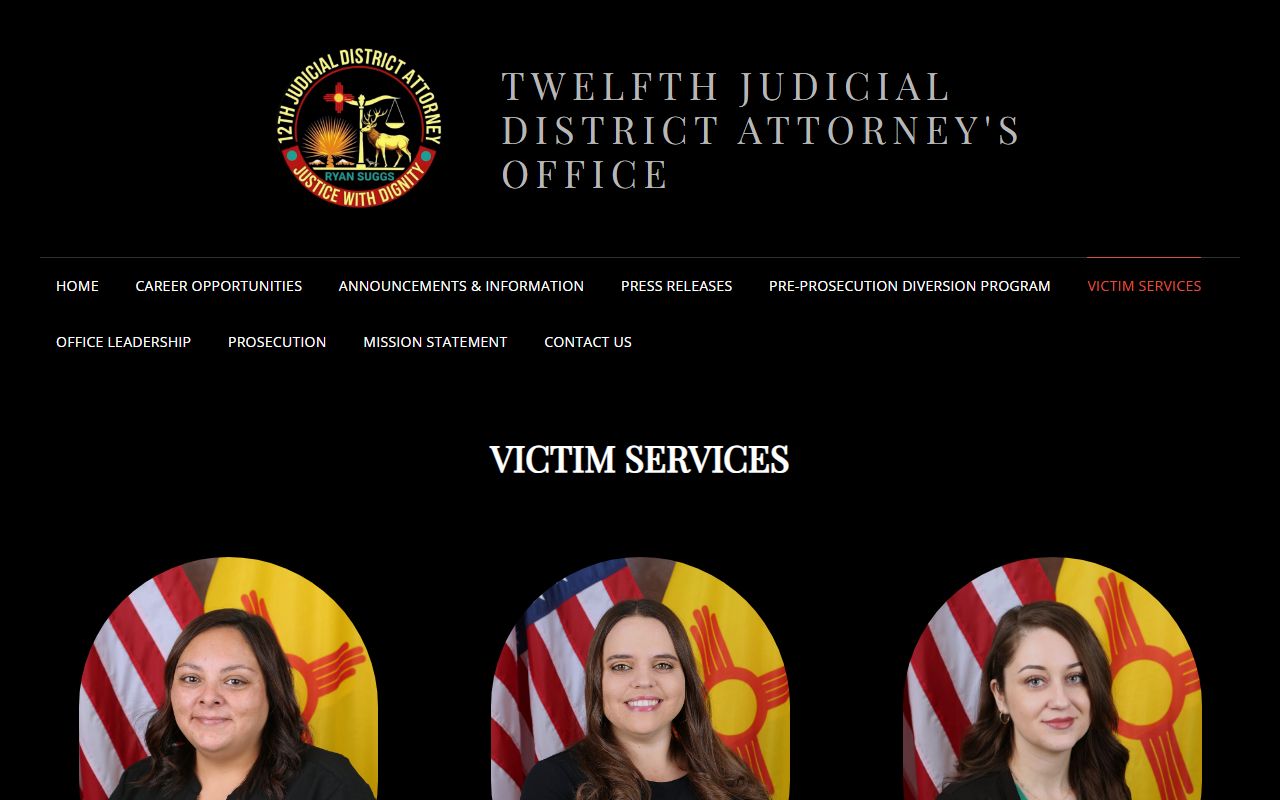
Victim-services information is part of the prosecution system that can run alongside charge filing and court events.
Charges vs Convictions
Otero County arrest records and court charge records can show allegations that never become convictions. A charge is the accusation filed in court. A conviction is a plea or finding that establishes guilt. This distinction is essential for fair reading because dismissed, reduced, amended, and acquitted charges can remain visible in case history unless sealing or expungement changes access.
| Charge | Conviction | |
|---|---|---|
| Meaning | Accusation after arrest or investigation. | Guilt established by plea, verdict, or court finding. |
| Proof Level | Based on legal filing and probable cause concepts. | Requires a valid plea or proof beyond a reasonable doubt at trial. |
| Record Reading | Must be checked against status and disposition. | Must be checked against sentence, appeal, sealing, and expungement history. |
Diversion and Filed Charges
The Twelfth Judicial District Attorney documents a pre-prosecution diversion program. The program cites the Pre-Prosecution Diversion Act, NMSA 31-16A-8. Eligibility limits include no prior violent felony, no prior felony for any crime in the previous 10 years, a non-violent alleged crime with a domestic-dispute exception that does not involve a minor, no revoked or unsatisfactory prior probation, no similar program in the prior 10 years, willingness to participate, and no alleged crime involving substantial sale or possession of controlled substances. The DA may decline even if criteria appear to be met.
The DA diversion page appears in the image sourced from the Twelfth Judicial District Attorney pre-prosecution diversion resource.
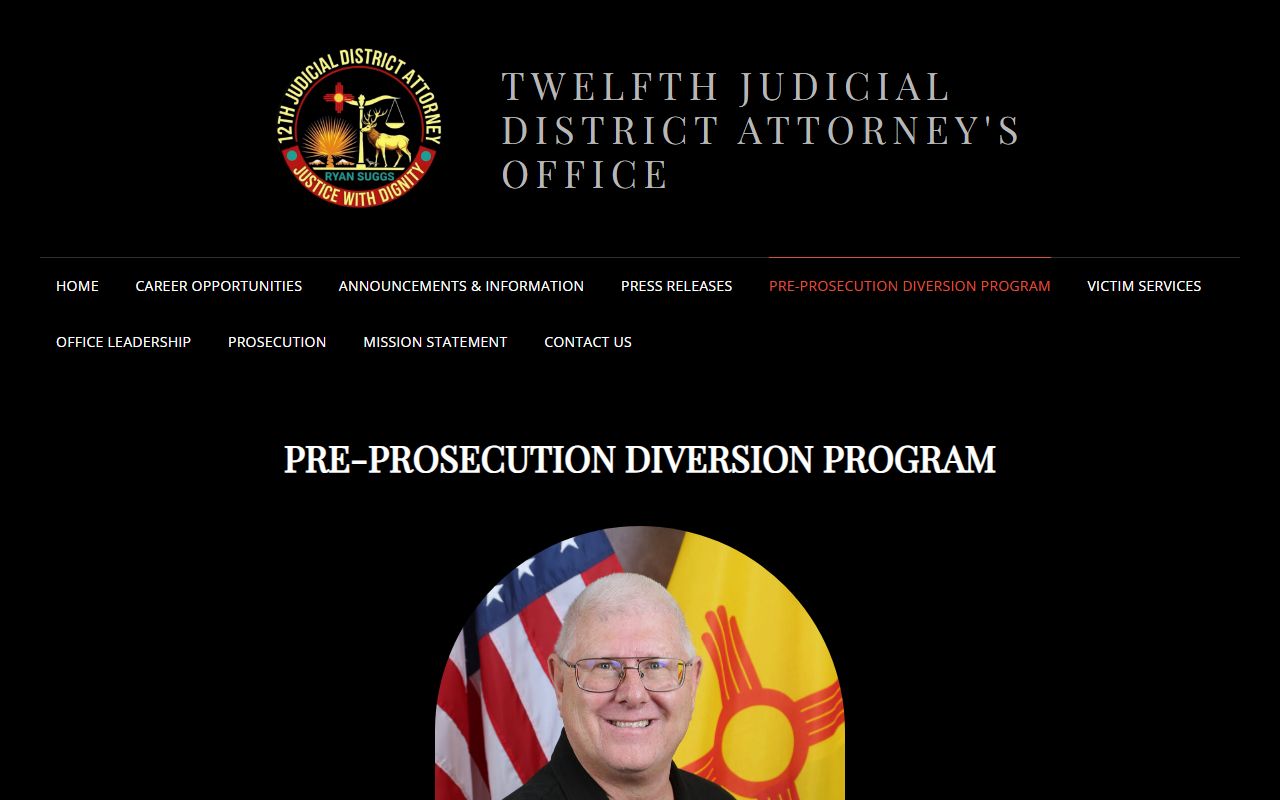
Diversion can affect how charges after arrest move through prosecution, but participation and record results depend on DA and court action.
Sealed vs Expunged Records
Sealing and expungement are two different access limits for Otero County arrest records and court charges. A sealed record is hidden from public access by rule, statute, or written court order. Expungement is a petition-based process under New Mexico's Criminal Record Expungement Act for qualifying arrest and criminal court records. New Mexico Courts provides forms for identity theft, release without conviction, and conviction categories. Otero cases are filed in District Court when that court has jurisdiction.
| Sealed | Expunged | |
|---|---|---|
| Public Access | Hidden from public view, but may still exist in court or agency custody. | Public access is limited after a qualifying petition is granted. |
| Examples | Juvenile, adoption, mental-health, protected identifiers, or court-ordered sealing. | Identity theft, release without conviction, or qualifying conviction records. |
| Practical Step | Ask the court that holds the record about access authority. | Use New Mexico Courts forms and file in the proper District Court. |
Charge Codes and Courts
Otero County charge records use court case numbers, case categories, charge text, and statute or offense descriptions where shown. District Court is the general-jurisdiction court for felony criminal cases. Magistrate Court handles misdemeanors, DWI/DUI, traffic, and felony preliminary hearings. Municipal Courts handle petty misdemeanors, DWI/DUI, traffic, and ordinances. Case Lookup observed examples include criminal and traffic categories, such as CR and TR, tied to court-location codes.
The City of Alamogordo traffic arraignment page appears in the image sourced from the official Alamogordo traffic information resource.
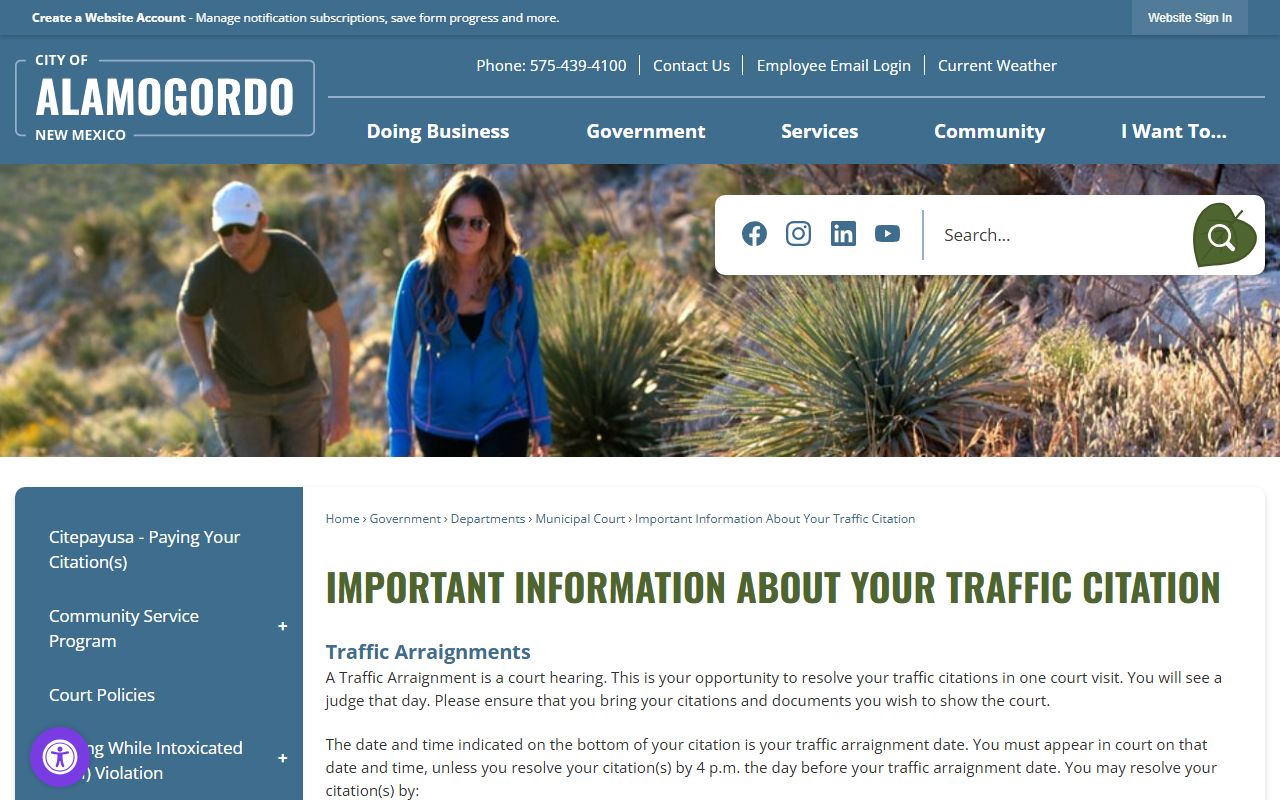
Traffic and DWI charges can involve municipal, Magistrate, or District Court depending on the citation, charge level, and case path.
Statewide Criminal Lookups
Statewide court case searching is handled through New Mexico Case Lookup, while registered document access may be available through re:Search NM depending on user category. NMCD Offender Search is not a county jail roster and covers people incarcerated in New Mexico Corrections Department custody or on probation and parole supervision. It explicitly does not cover county or city detention facilities. That means a person may be absent from NMCD even if recently arrested in Otero County and held locally.
For arrest-side records outside court custody, Otero County IPRA is the county fallback. County public records requests must include the requester's name, address, telephone number, and enough detail to identify and locate the record. The research states records must be made available immediately or as soon as practicable, no later than 15 calendar days, with a written response if inspection is not available within three business days.
Restricted Otero Charge Records
Public access has firm limits. Juvenile criminal cases are not shown on public Case Lookup. Protective-order cases are not displayed publicly. Rule 1-079 protects personal identifiers and automatically seals certain proceedings, including adoption and mental-health matters. A sealing order can cover the order, register of actions, or individual docket entries. Charges can also be missing from a public search when a case is sealed, expunged, filed under restricted access, not yet entered, or held by an agency rather than a court.
Background-check use has separate legal rules. Casual public searches of Otero County arrest records and court charges are not FCRA-compliant consumer reports. Verify with the originating court, sheriff, detention center, or District Attorney before relying on a charge status, especially when employment, housing, credit, insurance, or licensing consequences may follow.
Important: A filed charge is not a conviction unless the court record also shows a conviction disposition.
The DA press-release page appears in the image sourced from the Twelfth Judicial District Attorney press releases.
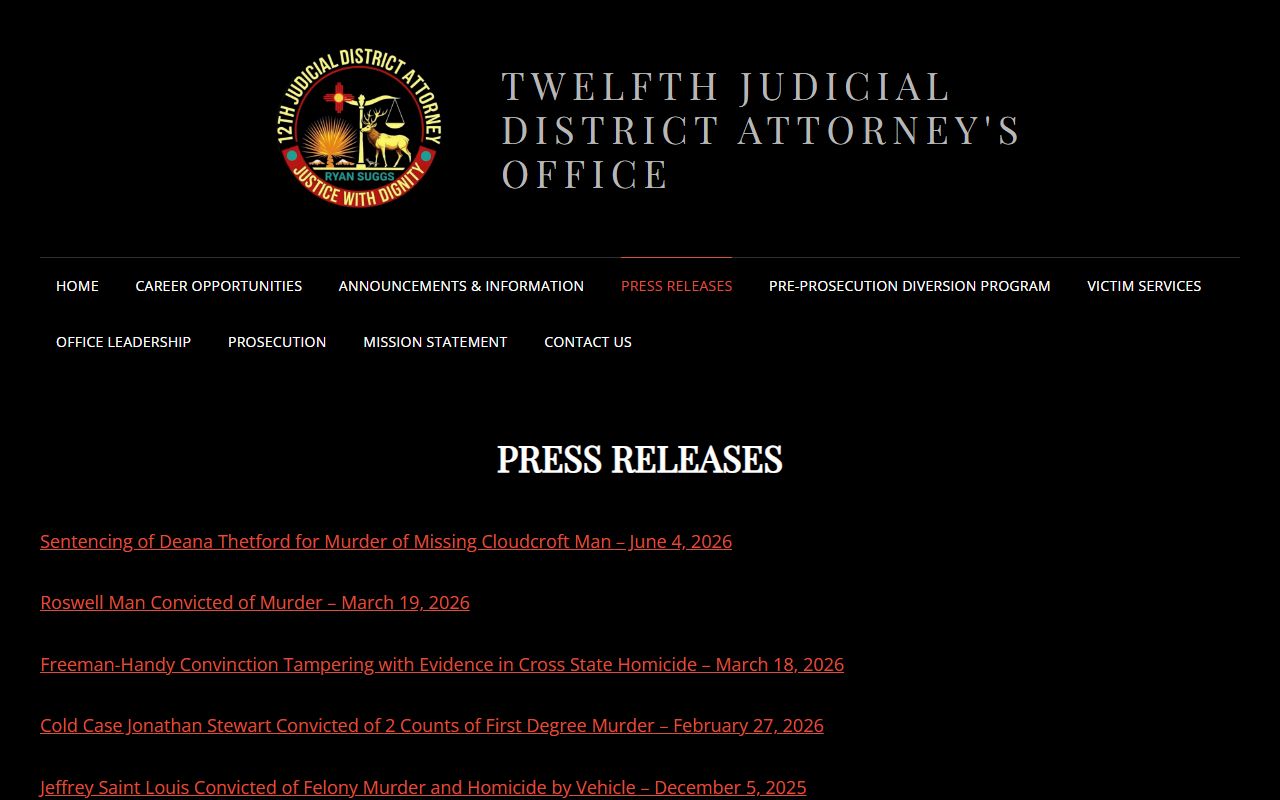
Press releases can describe prosecutions, but they are not substitutes for the filed court charge record and final case disposition.