
Otero Criminal Court Records
Otero County criminal court records are kept by the court that handles the case. Felony cases and felony-related proceedings move through District Court. Magistrate Court handles felony preliminary hearings, misdemeanors, DWI/DUI, traffic, and other limited-jurisdiction criminal matters. Municipal Courts handle petty misdemeanors, DWI/DUI, traffic, and local ordinance cases. The criminal court record begins when a case is filed with the court and grows as the case moves through hearings, orders, pleas, trial settings, disposition, and sentencing.
The court case file is not the same as an arrest record. Arrest data may come from a sheriff, detention center, or law-enforcement agency. The criminal court record is the clerk-maintained judicial file. For a closer look at the arrest-to-charge path, use the Otero County arrest records and charges page. For every court record type, including civil and family cases, use the broader Otero County court records page.
Search Otero Criminal Cases
Public Otero County criminal court record lookup starts with New Mexico State Judiciary Case Lookup. The portal provides public case data for District, Magistrate, Municipal, appellate, and other New Mexico courts. Use Name Search for a defendant-name search, Case Number Search when the full case number is known, or DWI Search for that specific search type. Otero-relevant court filters include Alamogordo District Court, Alamogordo Magistrate Court, and municipal court locations for Alamogordo, Cloudcroft, and Tularosa.
- Open Case Lookup and accept the judiciary disclaimer.
- Search by defendant name, full case number, or DWI search fields.
- Narrow by court type, Otero court location, case category, and date range when known.
- Review charges, docket entries, hearing dates, disposition, sentence, and warrant or bond entries when shown.
- Request certified copies or audio from the Otero District Court clerk when official documents are needed.
Public Case Lookup does not provide documents. re:Search NM provides Odyssey case information and documents to registered users, with access based on user profile. Secure Court Case Access requires credentials. For Otero District Court copies, the clerk's office uses the Twelfth District research email and lists copy requests through extension 112.
Older Otero criminal cases may need clerk help. The Case Lookup research notes that cases filed before statewide court automation was completed in June 1997 may be stored in a separate database depending on the court. If a known case is not online, the next step is to contact the court where the case was heard and ask about older criminal indexes, copy procedures, and any access restriction tied to the file.
Criminal Case Stages
A criminal court record can show each stage of the case, but the stage names should be read carefully. A complaint, information, or indictment is an accusation, not proof of guilt. Arraignment records show that charges were addressed and a plea may have been entered. Pretrial entries may include motions, continuances, bond orders, competency events, discovery issues, plea negotiations, or trial settings. The final court record should identify the disposition and, if there is a conviction, the sentence.
Case flow: Charges Filed › Arraignment › Pretrial / Motions › Plea or Trial › Disposition › Sentencing
| Stage | What Happens |
|---|---|
| Charges Filed | A complaint, information, or indictment starts the criminal case in court. |
| Arraignment | The defendant appears, charges are addressed, and a plea may be entered. |
| Pretrial / Motions | The court handles motions, discovery, continuances, bond issues, and trial settings. |
| Plea or Trial | The case resolves by plea, trial verdict, dismissal, or other court action. |
| Disposition | The charge or case outcome is entered in the record. |
| Sentencing | The court imposes jail, prison, probation, fines, fees, conditions, or other terms when a conviction exists. |
Otero Criminal Record Fields
Otero County criminal court records can include the case number, court type, court location, case category, defendant name, charges, pleas, disposition, sentence, probation terms, bond information, fines, fees, warrants, and hearing history. Case categories such as CR for criminal appear in observed case-number examples. Public websites redact protected identifiers and do not show documents. Juvenile criminal cases are not displayed through public Case Lookup, and some protected or sealed entries may be absent from public tools.
| Field | What It Shows |
|---|---|
| Case Number | The unique court identifier, often showing court type, location, category, and sequence. |
| Defendant | The person charged in the criminal case, subject to public-access limits. |
| Charges | The alleged offenses as filed, amended, reduced, dismissed, or resolved. |
| Plea | The defendant's formal response to a charge, such as guilty or not guilty when listed. |
| Hearings | Arraignment, pretrial, motion, plea, trial, disposition, sentencing, or review settings. |
| Disposition | The outcome of each charge or the case, such as conviction, dismissal, acquittal, or other action. |
| Sentence | Punishment or court conditions after conviction, including probation, bond, fines, fees, and custody terms when shown. |
The New Mexico Courts expungement resource appears in the image sourced from the official New Mexico Courts expungement page.
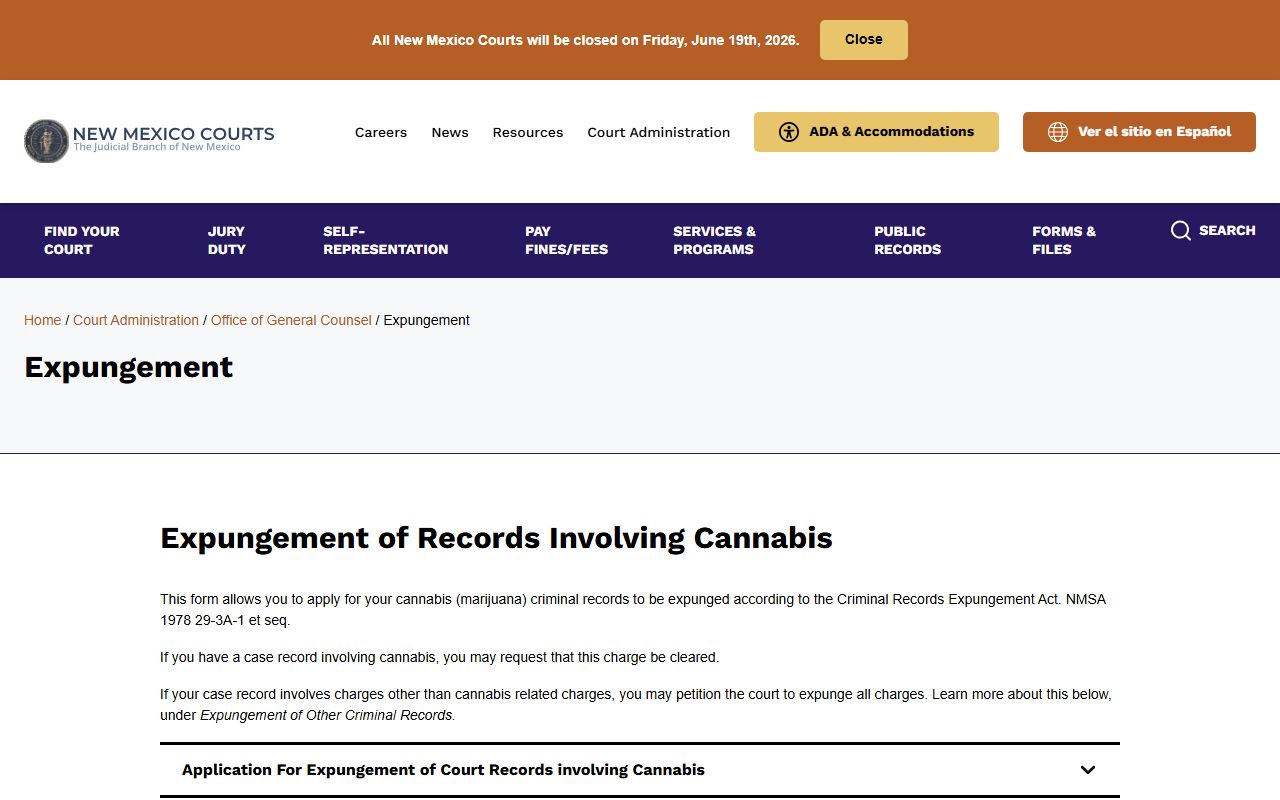
Expungement records can affect whether qualifying criminal court and arrest records remain available to the public.
Charges vs Convictions
Charges and convictions are not the same. A charge is an accusation filed in court. A conviction is the result of a guilty plea, trial verdict, or other court action that establishes guilt. Otero County criminal court records may show charges that were later dismissed, reduced, amended, or resolved with no conviction. Reading only the charge line can give the wrong impression if the disposition and sentence are ignored.
| Charge | Conviction | |
|---|---|---|
| Meaning | An accusation filed by complaint, information, or indictment. | A finding or plea that establishes guilt. |
| Where It Appears | Early in the court record and in charge lists. | In disposition, judgment, sentence, and final case entries. |
| Can Change | May be amended, reduced, dismissed, or dropped. | May be appealed, set aside, sealed, or expunged only through proper legal process. |
Dispositions and Sentences
The disposition line is the key to reading an Otero County criminal court record. A case can show guilty, not guilty, dismissed with prejudice, dismissed without prejudice, acquitted, or other court results. Dismissed with prejudice generally means the charge cannot be refiled in the same way. Dismissed without prejudice can allow refiling if the law permits. A sentence is separate from disposition and describes punishment or conditions after conviction.
- Disposition
- The outcome of a charge or case.
- Sentence
- The punishment or conditions imposed after conviction.
- Probation
- Court-ordered supervision instead of, or after, custody.
- Bond
- Money or conditions used to secure court appearance.
Sealed vs Expunged
Restricted access can change what the public sees in Otero County criminal court records. Rule 1-079 says court records are public unless sealed by order, rule, or law, and a record cannot be sealed just because both sides agree. New Mexico's Criminal Record Expungement Act covers qualifying arrest and court records through petition categories such as identity theft, release without conviction, and conviction cases. Expungement petitions for Otero cases are filed in District Court when that court has jurisdiction.
| Sealed | Expunged | |
|---|---|---|
| Public Visibility | Hidden from public access by rule, order, or statute. | Public access is limited for qualifying criminal or arrest records after the court grants relief. |
| How It Happens | Written court order, automatic rule, or legal restriction. | Petition process under Sections 29-3A-1 through 29-3A-9 NMSA 1978. |
| Examples | Juvenile, adoption, mental-health, and protected personal identifier material. | Identity theft, release without conviction, or qualifying conviction categories. |
New Mexico public-record database restrictions are reflected in the image sourced from the official NMOneSource legal database.
Because some statute pages do not expose stable direct section URLs, NMOneSource is the official access point for New Mexico statutory text.
Public Criminal Record Access
New Mexico public access for criminal case records is shaped by the Inspection of Public Records Act, Case Lookup database restrictions, court sealing rules, juvenile confidentiality rules, and expungement law. Section 14-2-1 NMSA 1978 makes public records generally open unless an exception applies. Section 14-3-15.1 governs state-agency records, copy fees, computer databases, and misuse restrictions. Section 32A-2-32 makes juvenile records confidential and keeps juvenile criminal cases out of public Case Lookup.
Key access point: Otero District Court records requests go through 12thdistrictresearch@nmcourts.gov or the local copy-request extension listed by the clerk.
The U.S. Bankruptcy Court for the District of New Mexico appears in the image sourced from the federal bankruptcy court website.
Federal bankruptcy records are separate from Otero criminal cases, but the image helps distinguish state criminal court access from unrelated federal court systems.
Restricted Otero Criminal Records
Public Case Lookup does not show juvenile criminal cases, Social Security numbers, full birth dates, protected addresses, or other protected identifiers. Family Violence Protection Act order-of-protection cases are also not displayed publicly. Adoption and mental-health proceedings are automatically sealed under Rule 1-079. A case record may also have sealed individual docket entries, a sealed register of actions, or a sealing order that limits what can be viewed.
Casual public searches are not employment, housing, credit, insurance, or tenant-screening background checks. Those uses are regulated by the Fair Credit Reporting Act and other laws. For Otero County criminal court records, verify case status with the originating court before relying on a docket entry, especially when a charge has been amended, reduced, dismissed, sealed, or expunged.
Important: Do not treat a filed charge as a conviction unless the court record shows a conviction disposition.